← Features·Digital Product

Sell Digital Products Online —
PDFs, ebooks, presets, templates.

Sell digital products online from your own creator store, including PDFs, ebooks, templates, presets, audio, videos, and other downloadable files.

  • Instant file delivery
  • Dedicated product sales pages
  • Keep your customer data
No card 14 days free 0% commission
Sell digital products online from your creator store
What you can sell

What digital products can you sell?

If you can save it as a file, you can sell it. Upload from your computer — we handle the delivery.

PDFs & eBooks

Guides, scripts, magazines, photo books, recipe collections, workbooks.

Templates

Notion, Figma, Canva, Word, Excel, Google Docs, Photoshop, After Effects.

Presets

Lightroom presets, Capture One styles, LUTs, mobile filters, color grades.

Audio

Music tracks, sample packs, beats, sound effects, podcast episodes.

Video

Tutorials, masterclasses, stock footage, animations, motion graphics packs.

Workout & meal plans

PDF programs, spreadsheets, video guides, exercise libraries.

Fonts & icons

Typography files (OTF, TTF, WOFF), icon packs (SVG, PNG), design assets.

Bundles

Pack a PDF + video + spreadsheet into a single Bundle — one product, one price. Calendar products excluded.

How to create

How to create a digital product in 3 steps

Three required steps get your product live — Thumbnail, Checkout, Options. Two more are optional polish: SEO settings and a personalized confirmation email. Do them now, come back later, or skip entirely. The defaults work.

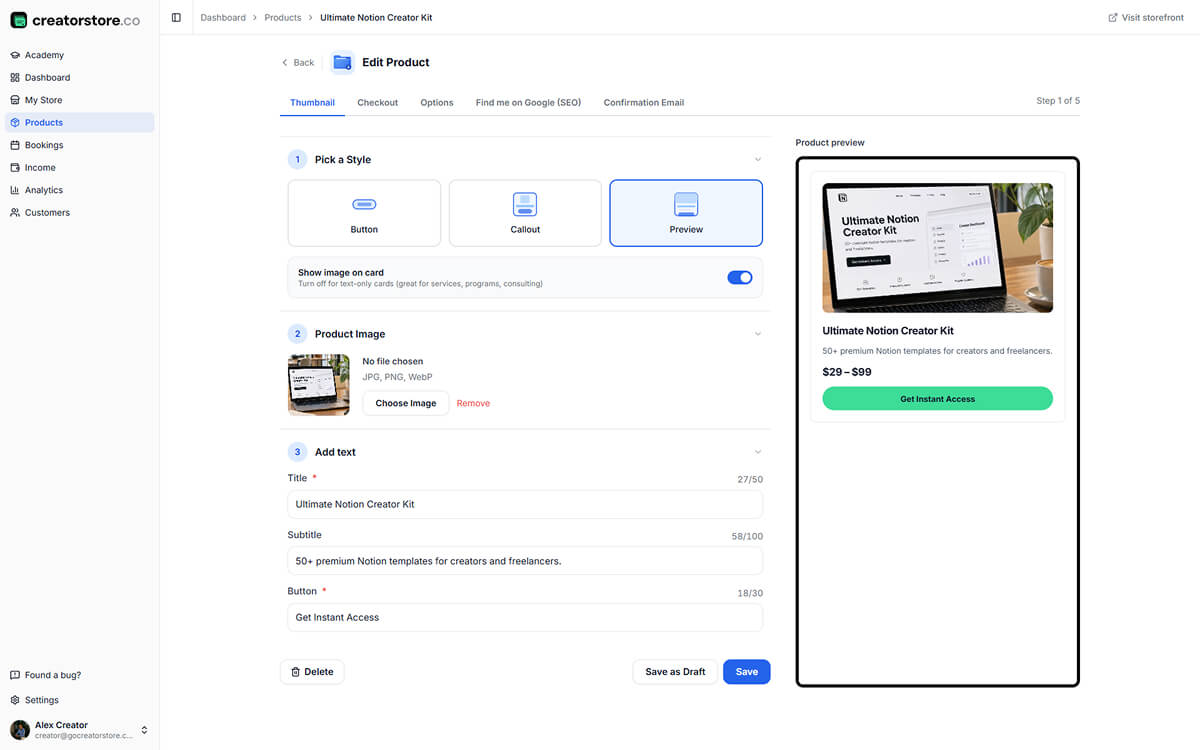
Admin Step 1 — Thumbnail: pick card style, upload image, add title and button text
Required
Step 01 · Thumbnail

Choose your product card style

Three card layouts to pick from — a big Preview card with an image and CTA, a horizontal Callout for compact stores, or a Button that's just tap-to-buy. Upload the product image, add a title, subtitle, and button text. Whatever you type shows up in the live preview on the right, so you're not guessing what it'll look like.

  • 3 card styles + "Show image on card" toggle
  • Live storefront preview updates as you type
  • Character counters for title/subtitle
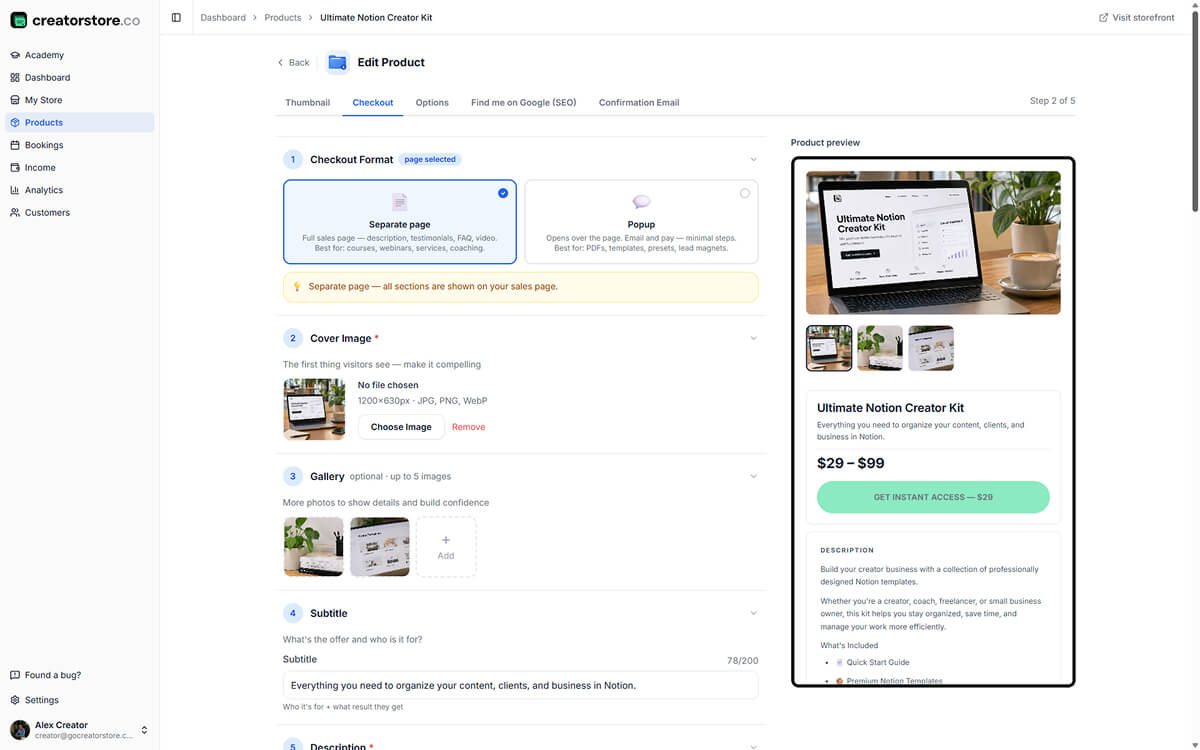
Admin Step 2 — Checkout: sales page builder with cover, gallery, description, video, guarantee, testimonials, FAQ
Required
Step 02 · Checkout

Build your sales page

This is where the sales page actually gets built. A cover image plus up to five gallery shots. Subtitle and a proper rich-text description with lists and links. A pitch video from YouTube, Loom, or Vimeo if you want one. A guarantee block. Testimonials with ratings. A categorized FAQ. And if you need to collect anything at checkout beyond email — custom fields.

  • Separate page or popup checkout format
  • 5 guarantee preset chips + custom text
  • Testimonials with photo/initials + 0–5 rating
  • FAQ tagged: Access · Refund · Format · Support · Suitability
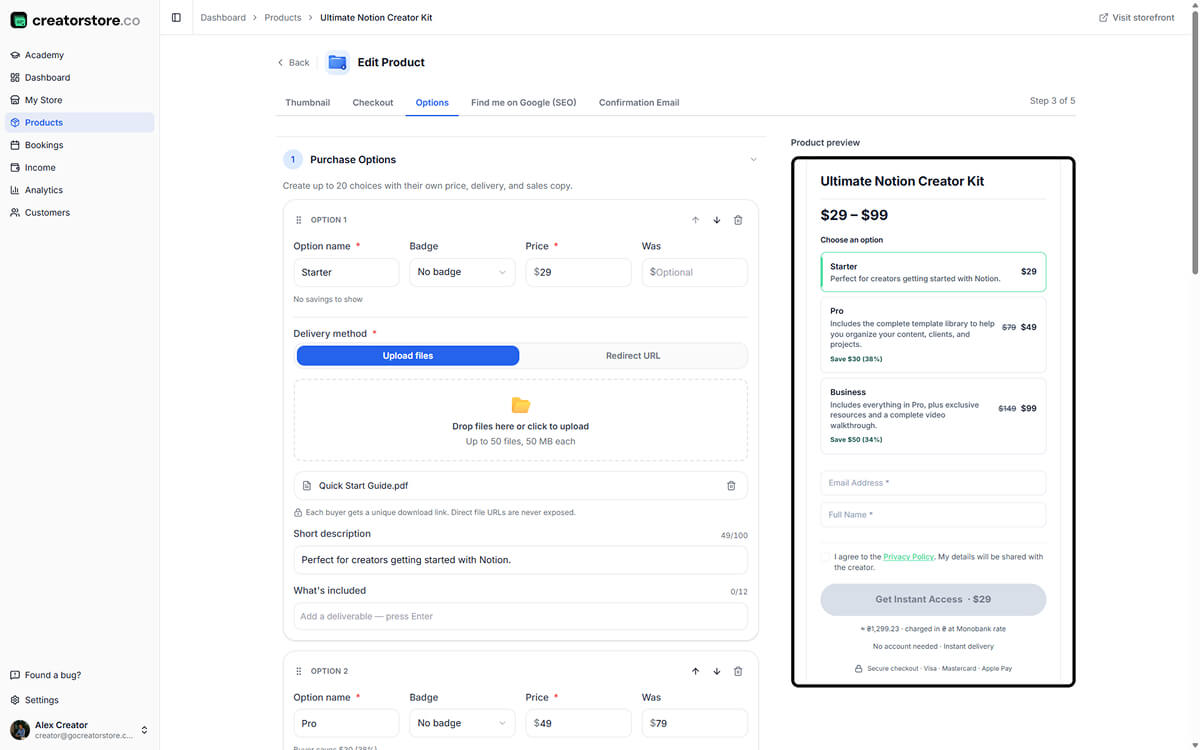
Admin Step 3 — Options: multi-tier pricing with Starter/Pro/Business, file uploads, savings calculator
Required · Product goes live after this step
Step 03 · Options

Set up pricing tiers

You can have up to 20 pricing tiers on the same product — Starter, Pro, Business, whatever makes sense for what you're selling. Each tier gets its own price. Add a "was" price if there's a discount and the savings percentage calculates itself — buyers see "Save $30 (38%)". Files upload per tier, or you can redirect to your own storage. Short description and a "What's included" list for each. Once you save this step, the product is live on your store.

  • Up to 50 files per tier × 50 MB each
  • Per-tier files or external URL redirect
  • Savings display: $, %, or both
  • Currency selector + shared T&C
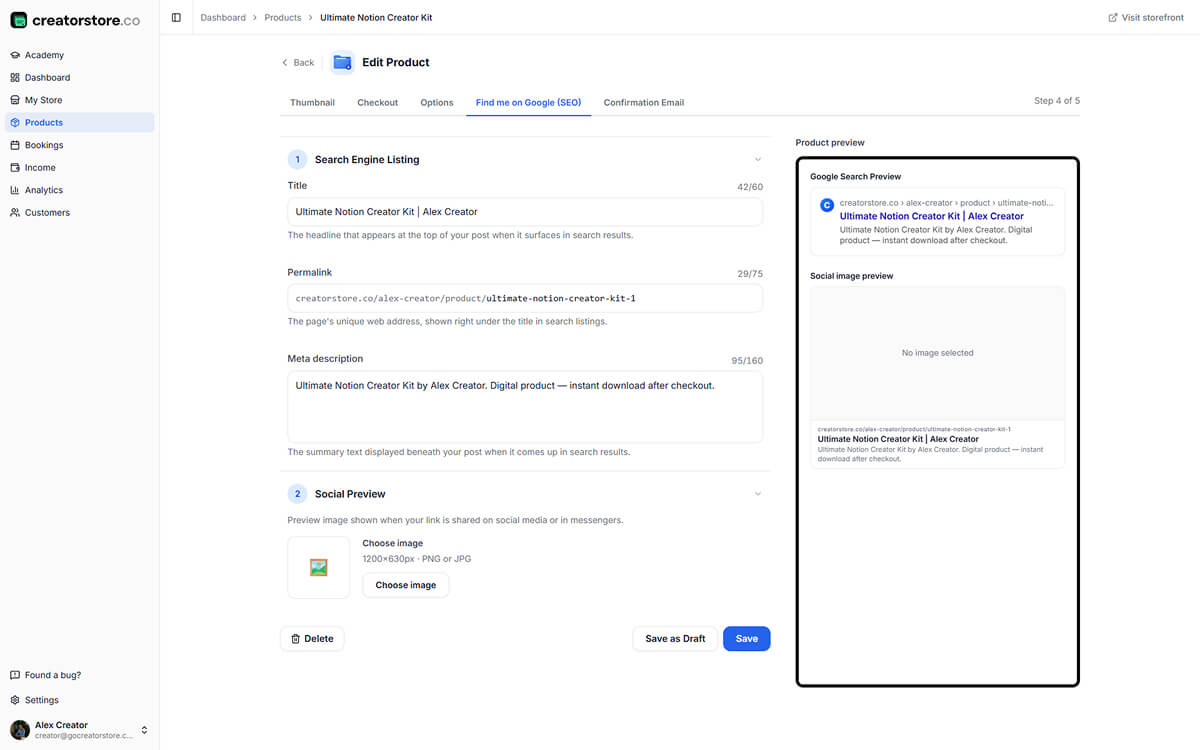
Admin Step 4 — SEO: meta title, permalink, description with live Google search preview
Optional · Add anytime
Step 04 · Find me on Google

Get found on Google

Standard SEO stuff, but visual. Type your meta title, permalink, and meta description — character counters run so you don't overshoot Google's cut-off (60, 75, and 160 characters respectively). On the right, a live Google preview shows exactly how your product will look in search results. Same for the social image if you upload one — see the FB/LinkedIn card before it goes public.

  • Live Google snippet preview
  • Social image (1200×630) with live preview for FB/LinkedIn/Slack
  • Auto-generated permalink from title
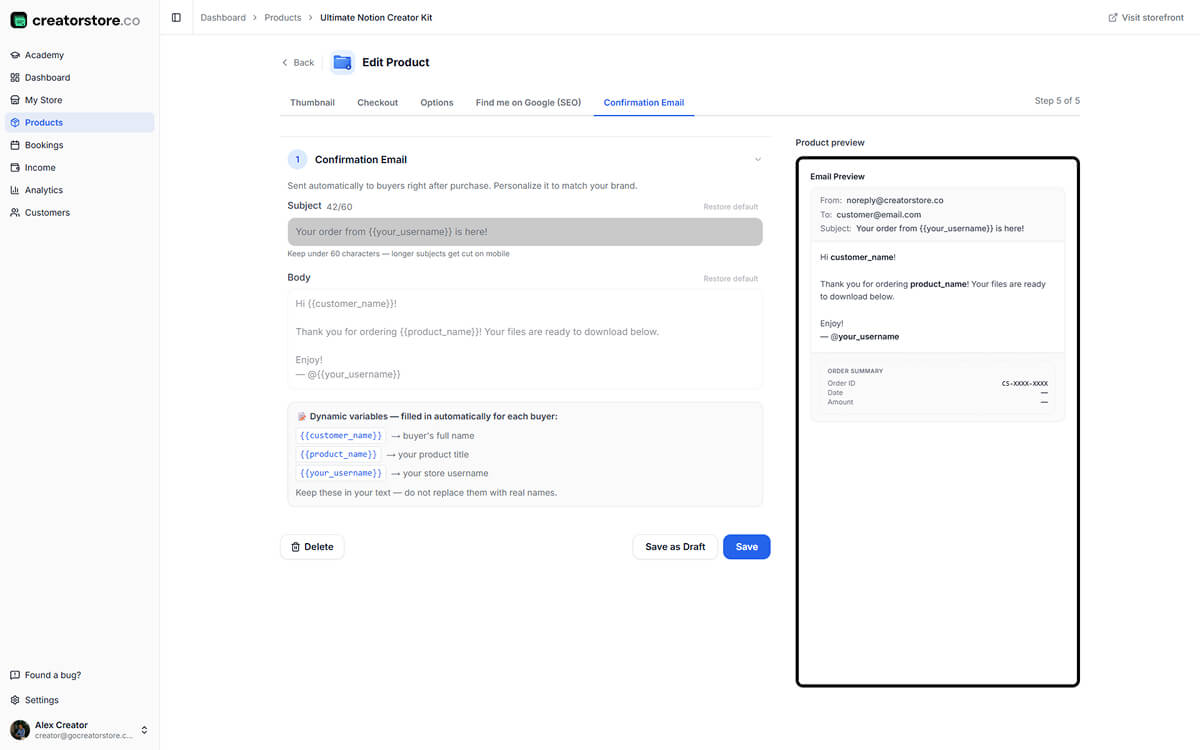
Admin Step 5 — Confirmation Email: customize subject and body with dynamic variables, live email preview
Optional · Default works out of the box
Step 05 · Confirmation Email

Personalize the confirmation email

The default email works fine, but you can rewrite it to sound like you. Edit the subject and body, drop in variables like {{customer_name}}, {{product_name}}, or {{your_username}} — they fill in per buyer automatically. On the right you see exactly what the email will look like, Order Summary block included.

  • 3 dynamic variables + more coming
  • Live email preview with Order Summary
  • Order ID, date, amount auto-generated
  • "Restore default" button
Create your first product →

Free plan · No card required · Live product in 10 minutes

Built to convert

Sales-page blocks — from cover to FAQ

Eight built-in sections — turn them on/off per product. No coding, no Webflow, no plugins.

Cover & Gallery

Main cover image plus up to 5 additional photos — perfect for before/after, inside-pages, mockups.

Sales pitch video

Embed a YouTube, Loom, or Vimeo link. Sales pages with a pitch video tend to convert noticeably better on cold traffic.

Guarantee

Add a guarantee block with one click — 30-day money back, no questions asked, or try-risk-free presets included.

Testimonials

Up to 3 customer quotes with star ratings — critical social proof for cold traffic.

What's Included

Structured list of what's inside — item description + type/format. Helps buyers decide faster.

Who It's For

Self-qualifying audience tags — "Freelancers", "Course creators", "Beginners". Filter the right buyers in.

Bonus Items

List extra items included — boosts perceived value without raising the price.

Product FAQ

Answer objections before they arise. Quick-add templates for Refund, Format, Delivery, Skill level, Updates.

What buyers see

How your digital product looks on the site

Once your product is live, buyers see it in three places — as a card on your store, as its own sales page (that Google indexes), and inside the multi-tier pricing box if you offer more than one option. Real example: creatorstore.co/@alex-creator.
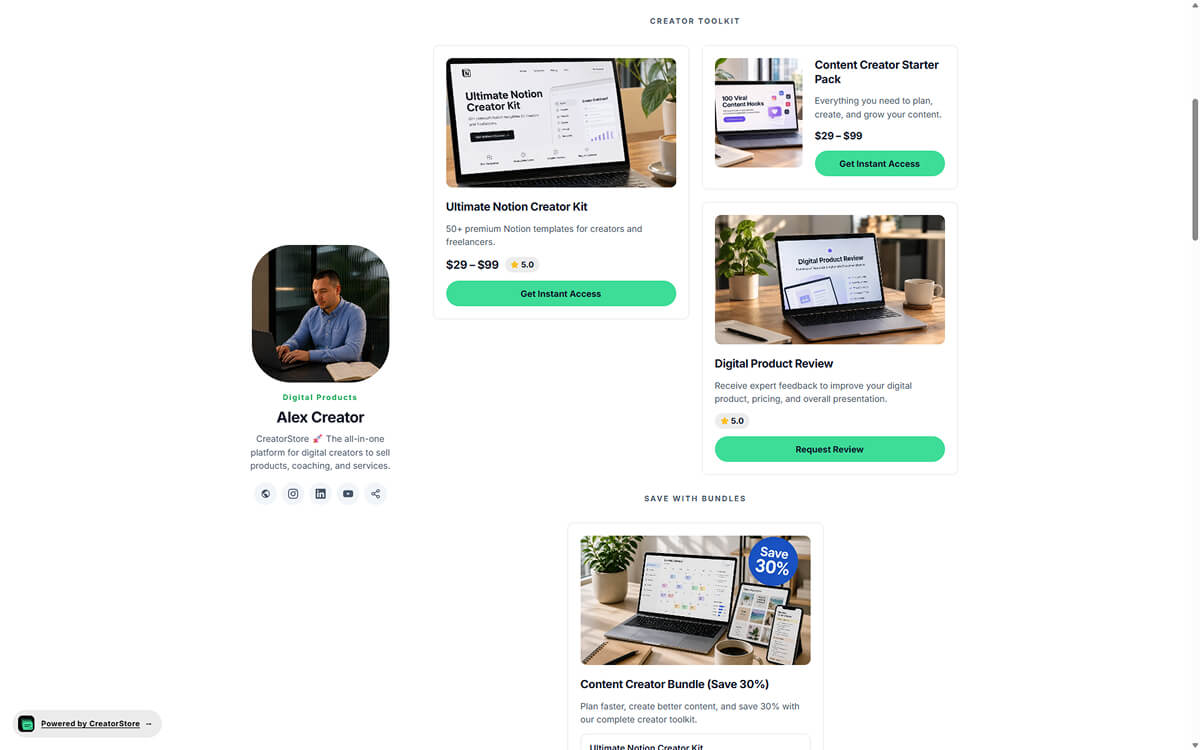
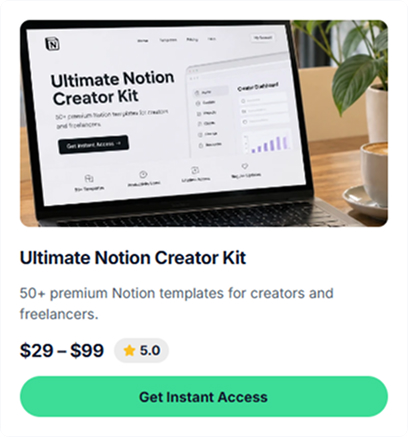
Digital product widget as it appears on your store page
View 01 · On your store

Your product as a store card

Your digital product sits on your CreatorStore page as a clean card — the image, title, subtitle, and buy button. Buyers see it in the same glance as the rest of your store. One tap and they're either buying through a popup or opening the full sales page.

  • Three card styles to pick from (Preview, Callout, Button)
  • Sits inside your storefront layout — no external redirect
  • One tap: buy via popup or open full sales page
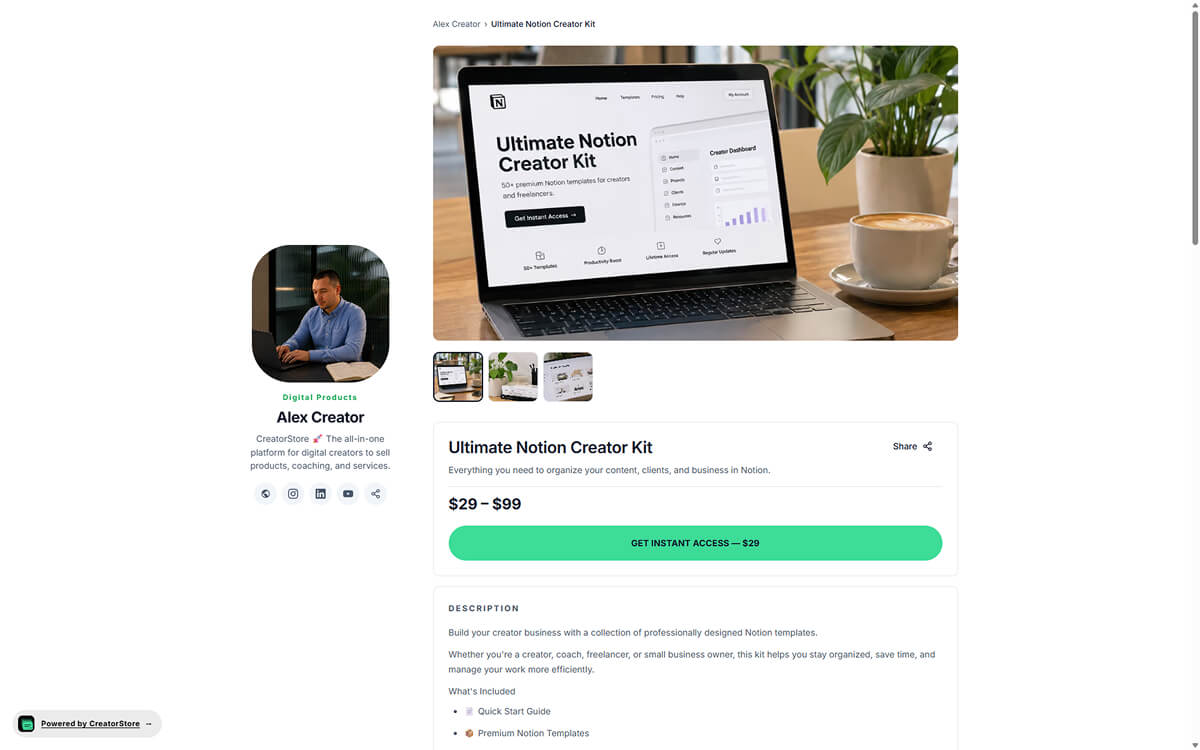
Dedicated product sales page — indexed by Google with full product details
View 02 · Product page

Your own sales page — indexed by Google

Every product gets its own page, on its own URL. Google crawls it and can send organic traffic straight to the sale. This page holds everything a buyer needs to decide — cover image, gallery, video, description, testimonials, guarantee, and FAQ. Nothing else in the way.

  • Its own URL, own meta title and description
  • Indexed by Google automatically
  • Full sales page: video, testimonials, guarantee, FAQ
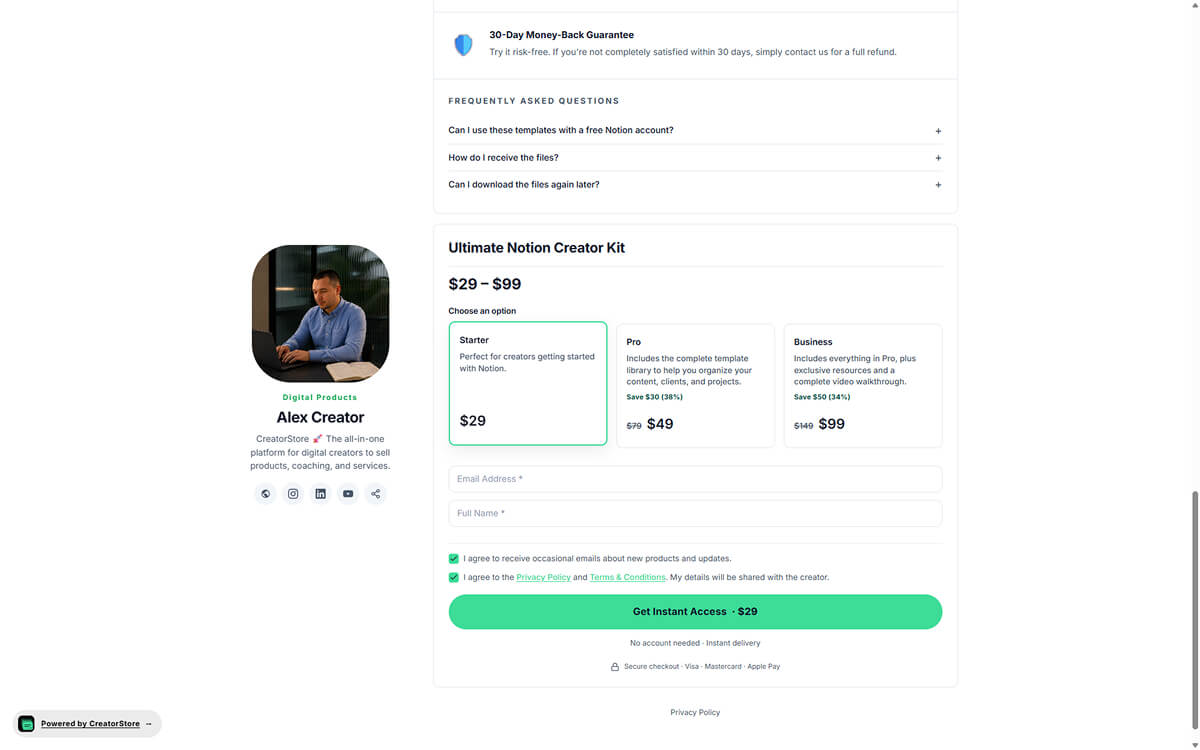
Multi-tier pricing box — Starter, Pro, Business with different prices and files
View 03 · Pricing tiers

One product, several bundles

Different buyers want different things. Show up to 20 tiers of the same product — each with its own price, files, and included items. Buyer picks the option that fits them, the checkout adjusts. The savings between tiers show automatically ("Save $30 · 38%"), so the upsell does itself.

  • Up to 20 tiers per product (Starter / Pro / Business, etc.)
  • Auto-calculated savings on discounted tiers
  • Different files and "What's included" list for each
See a live example →

Real creator store — click around to see how products actually work

Behind one sale

How digital product delivery works — from payment to download

From payment to download — every step is automated. You don't touch anything after the buyer clicks "Buy".

01
Pay

Buyer pays

Apple Pay, Google Pay, cards via Stripe, or PayPal. Whichever method the buyer prefers.

02
Confirm

Payment confirms

Usually within seconds. The system triggers delivery automatically — no manual steps.

03
Email

Email sent

Your customized confirmation email lands in their inbox with a secure single-use download link.

04
Download

Buyer gets the file

One click → download. Files up to 200 MB, any format. Or redirect to your external storage instead.

Lead magnet or paid

Sell paid digital products or offer free lead magnets

Some products grow your list. Others pay the bills. Sell both from the same store — no extra setup.

Lead magnet

Set buyer price to $0

Collect emails instead of cash. Build your list, deliver instantly. Replaces ConvertKit forms + Mailchimp lead pages.

  • Email capture
  • Instant delivery
  • Auto-added to your email list
Paid product

Any price you set — you keep 100%

Set your buyer price, add a sale price with discount auto-calculated. Stripe and PayPal handle payments — you keep what you earn.

  • 0% commission — keep every cent
  • Sale price with discount %
  • Stripe + PayPal · Apple/Google Pay
About

Selling digital products online — how it actually works

Every digital product on CreatorStore follows the same short path: upload a file, set a price, publish the page. A buyer checks out, Stripe or PayPal handles the payment, and we email them a single-use download link within seconds. You don't touch delivery. You don't resend broken files. You don't chase people for payment. Full walkthrough on how to sell digital products if you want it.

The things you'd normally hire someone to set up — Stripe integration, a Terms of Service, a Privacy Policy, a Refund policy, the actual sales page with a cover, a gallery, testimonials, and SEO controls — all of that comes ready-made. It's not fancy, but it's the stuff nobody wants to build twice. Your files stay yours. Your customer list stays yours. Every dollar that comes in lands in your bank account.

Why creators are switching to digital products

Ten years ago, if you had 30,000 followers on Instagram, your income came from brand deals. Maybe some affiliate links. Ad revenue on YouTube if you were on YouTube. Everything else was noise.

That's changed. Creators got tired of relying on sponsorships that ghost after one campaign, or platform payouts that pay pennies per view. Selling a $29 PDF or a $49 Notion template to 100 of your followers is $2,900 or $4,900 in a weekend — and it happens whether Instagram feels like showing your posts that week or not.

Goldman Sachs put the creator economy at around $250 billion a couple years ago, with projections it could roughly double by 2027. But the more interesting shift isn't the total number — it's how much of that revenue now comes from creators selling their own stuff instead of getting paid by brands. That share keeps growing.

Digital products vs. services vs. physical goods

Here's what makes digital products different from selling t-shirts or offering consulting.

Cost per sale. When you print a t-shirt, you pay for the shirt, the printing, and the shipping — every single time. When you sell a consulting hour, you spend an hour. Sell a PDF? Copy #2, copy #50, and copy #5,000 all cost you nothing extra. The work happened once, upfront.

Ceiling. A one-person clothing brand caps at maybe 200 units a month before the supply chain becomes a real job. A consultant caps at how many hours they can work — 40 a week, tops. Digital? There isn't really a ceiling. The same PDF sold once or ten thousand times takes about the same amount of your time.

Fulfillment. No packages, no returns, no lost shipments. Someone pays, they get the file, done. Refunds are one click, not a customs form.

That's why creators who go digital-first tend to make significantly more than creators who stay in services — same audience, but the math is completely different.

Who does well selling digital products

A quick sense of who this actually works for.

Coaches and consultants who package their frameworks into templates or workbooks. Instead of five client calls a week, they sell the same $47 workbook 40 times. Same expertise, different distribution. Some of them keep offering 1:1 coaching alongside it.

Designers who sell what they already build for clients — Figma UI kits, Notion setups, Canva templates. Usually $19 to $49 each.

Course creators. This is the obvious one, and it works. Video-based courses, PDFs, sometimes a private community bolted on. Prices go from $99 to $499 and beyond.

Photographers with Lightroom presets. Small niche, but a good one. Prices usually fall between $12 and $40.

Developers selling boilerplates, code snippets, or automation. There's a whole cottage industry of $19 developer utilities pulling in solid recurring revenue.

Writers, newsletter operators, prompt engineers — anyone whose expertise fits inside a text file. Ebooks, guides, prompt libraries, template packs.

None of these people are guessing what to sell. They already know their audience. The product is just the packaging around something they already do.

From zero to first sale: how long it really takes

If you already have people following you — even 500 who actually read your stuff — you can be selling by tomorrow.

The store takes an afternoon: upload the file, write the page, pick a price. First announcement goes out — usually a mix of email and one or two social posts. First sales tend to show up in the first day or two, from people who were already waiting for you to launch something.

Then it's iteration. Someone will email asking a question. Someone else will suggest a feature. Reviews start showing up. You put testimonials on the page. Weeks 2 through 4, roughly.

By month two or three, creators with a decent audience are usually pulling in real money — anywhere from a few hundred to a couple thousand a month from one product. Second and third products come after that, once you know what people actually want.

If you don't have an audience yet, this timeline gets much longer. You need to build one first — usually six to twelve months of consistent content on one platform before selling makes sense. A free lead magnet is the usual first step, then a paid product once people know you.

One thing worth mentioning: the creators who do best aren't the ones with the slickest products. They're the ones who actually talk to their first buyers. Reply to DMs. Answer emails. Ask what could be better. It sounds obvious, but most people skip it — and that's where the real feedback lives.

FAQ

Digital product questions & answers

Anything else? Reach out — we reply within 24 hours.

What file types can I sell?
Any format works. For larger deliverables or bundles of multiple files, we recommend zipping them into a single ZIP archive and uploading that — it keeps delivery clean and ensures buyers get everything in one click.
How fast do customers get their file?
The instant payment is confirmed by Stripe or PayPal — usually within a few seconds. An email with the download link arrives automatically.
Can the download link be shared?
Each buyer gets a unique single-use link tied to their order. The direct file URL is never exposed.
How do I set the currency for my product?
When you create a product, you can choose the currency you need for it. Different products in your store can use different currencies.
Do I pay extra to sell digital products?
No. CreatorStore takes 0% commission on your sales — you only pay Stripe or PayPal's standard processing fee.
What tools does this replace?
For most digital sellers: Gumroad, SamCart, SendOwl (for selling & delivery) + Carrd or Webflow (for the sales page) + Termly or iubenda (for legal docs). One platform, one plan — see pricing.
What are the best digital products to sell in 2026?
The top-selling digital products right now: Notion templates ($15–99), design templates for Canva/Figma ($10–50), Lightroom presets ($12–40), online course files (PDFs + videos, $49–299), music sample packs ($20–80), and workout/meal plans ($15–60). Best sellers share three traits: solve a specific problem, save the buyer time, and pair well with your existing audience niche.
How much can you earn selling digital products online?
Real numbers vary widely: solo creators typically earn $500–5,000/month within 6–12 months. Top sellers hit $10K–100K/month. What matters most: pricing (higher tier = higher revenue per sale), audience size, and product quality. With 0% platform commission you keep more per sale — the same $30 product on Gumroad nets $27, on CreatorStore nets $30.
Do I need a business license to sell digital products online?
In most countries, no — you can start selling as a sole proprietor. Requirements depend on your country and revenue level. In the US, register for a tax ID when revenue exceeds $600/year. In EU, register for VAT if you cross the threshold (varies by country). CreatorStore auto-generates Terms & Privacy Policy so you're legally compliant from day one.
How to price digital products?
Rule of thumb: price based on outcome, not effort. A $19 PDF that saves 10 hours = clear win. Common price ranges by type — templates $9–49, presets $12–40, courses $49–299, coaching packages $150–1,500. Test with 3 tiers (Starter/Pro/Business) and see which converts best. CreatorStore's multi-tier pricing auto-calculates savings so buyers see "Save $30 (38%)".
What's the best platform to sell digital products?
Depends on priorities. Gumroad: easy but 10% commission + you don't own the domain. Etsy: built-in traffic but 6.5% fee + you compete with millions. SamCart: strong checkout, but $79/mo minimum + no built-in bio link. CreatorStore: 0% commission, own domain, multi-tier pricing, sales page + link-in-bio + booking all in one — $9/mo entry plan. For solo creators who want to own their audience, CreatorStore is optimized for that.
How to protect digital products from being resold or pirated?
CreatorStore protects each sale with a unique single-use download link tied to the buyer's order. The direct file URL is never exposed. For extra protection: watermark PDFs with buyer email (some sellers do this), require account login before download, and monitor for unauthorized shares. Piracy can never be 100% prevented, but these steps stop 95% of casual sharing.
Do I need to pay taxes on digital product sales?
Yes — digital sales are taxable income in most countries. In the US, report on Schedule C if sole proprietor. In EU, VAT applies to buyers in EU countries (Stripe handles this via automatic tax if enabled). CreatorStore provides sales reports you can export to CSV for your accountant. Consult a local tax advisor for your specific situation.
Can I sell digital products through Instagram, TikTok, or YouTube?
Yes — that's the primary use case for CreatorStore. Your store becomes your link-in-bio destination. Add the URL to Instagram bio, TikTok profile, YouTube channel description, and any pinned posts. Every click sends traffic straight to your products with checkout — no third-party redirect, no platform commission, no lost customer data.
How to promote and market digital products?
Top 5 marketing channels for digital products: 1) Content marketing (YouTube tutorials, TikTok demos, Instagram Reels showing the product in use). 2) Email list building via lead magnets — offer a free sample to grow your list. 3) SEO-optimized sales pages (CreatorStore has built-in SEO controls). 4) Testimonials and reviews from early buyers. 5) Paid ads to a proven-converting sales page. Start with content marketing — it's free and compounds over time.
Start now

Ship your first download
this afternoon.

One platform. 0% commission. Instant secure delivery.

✓ 0% transaction fees · ✓ Instant secure delivery · ✓ Cancel anytime