If you build your business on Instagram, TikTok, YouTube or another social app, you already know the hard truth: you don’t control the algorithm. Reach can drop overnight. A post that should do well can flop. And a launch can hinge on timing you can’t predict. That is exactly why email marketing automation for creators has become such an important part of running a sustainable creator business.
Email marketing automation gives creators something they actually own. Instead of just hoping people see the content, creators can collect leads, guide them through a creator email funnel and move them toward a sale, booking or signup on their own terms. Social media still matters. Email becomes the system that turns attention into income.
The numbers back it up. 81% of professional creators use an email marketing tool , and one in four full-time creators says email gives them their best audience engagement . Automated flows also beat one-off broadcasts by a lot, with standard campaign click rates averaging 1.69% while automated flow click rates average 5.58% . That’s a pretty big gap. A solid reason to build a real system instead of sending random newsletters.
This guide shows how to set up email capture and lead magnets, build a simple nurture sequence, segment your audience, connect your store or booking page, track the right metrics and keep the whole system lean. Not huge. Just useful. Build something that works, then keeps working as the business grows.
Why email marketing automation for creators matters for owned audiences
A lot of creators wait too long to start email. They think they need a big list, a polished brand, or a full weekly newsletter plan before they begin. They don’t. They need a way to move followers into an owned audience they can reach at any time.
Email works because it sits at the center of the business. Social platforms bring discovery, while a storefront or booking page handles the transaction, and email builds the relationship between those two points. A creator email funnel helps people move from ‘I saw your post’ to ‘I trust you’ to ‘I bought from you.’
The numbers make the case clearly. Kit says creators average a 44% open rate , which stands out next to the broader 35.63% average open rate reported by Mailchimp. It also found that 51,741 creators used email automations in 2023 , and those creators sent more than 28.4 billion emails . Email isn’t a side tactic anymore. It’s a normal part of creator business infrastructure.
Key email marketing benchmarks for creators
| Metric | Value | What it means for creators |
|---|---|---|
| Professional creators using an email tool | 81% | Most serious creators already treat email as core |
| Kit creator average open rate | 44% | Creator audiences can be highly engaged |
| Standard campaign click rate | 1.69% | One-off emails often underperform |
| Automated flow click rate | 5.58% | Automation usually drives stronger action |
If creators rely only on social platforms, they’re renting the audience. Build an email list, and they own the relationship. That matters even more for creators who sell digital products, coaching, services, webinars, or courses.
Start with a simple funnel for email marketing automation for creators
A lot of creators build too much into their first system. Too many forms, tags, and email branches get added fast, and then the whole thing stalls before it’s really done. As a result, it never gets finished. It’s better to build the smallest useful funnel first.
A basic creator email funnel has four parts:
1. Capture
Email capture and lead magnets go here. Someone clicks from a social bio, story, profile, or video description, then lands on a page with a clear offer.
2. Deliver
As soon as they opt in, they get the free thing they asked for, maybe a checklist, short guide, template, workshop replay, or discount code.
3. Nurture
Over the next few days, they get a short welcome sequence. It builds trust, shows how you work, and guides them to your paid offer.
4. Convert
Invite them to take one next step: buy a product, book a call, join a webinar, or apply for coaching. Start with one main action. Keep it simple.
Keep the flow clear and direct, so a follower sees your content, joins your list, gets value quickly, learns more about you, and then sees an offer that actually fits.

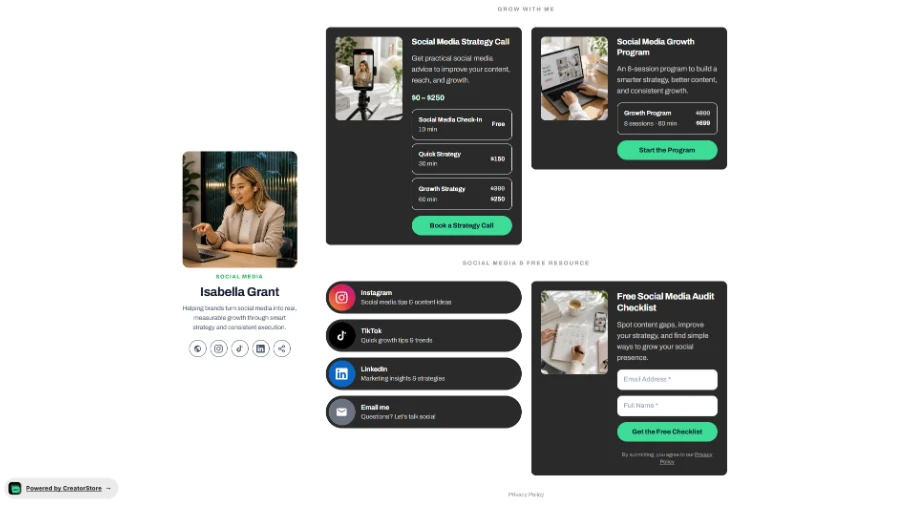
The best systems feel easy for the subscriber. One form. One promise. One welcome path. If you sell through creatorstore.co, it gets even simpler, because your landing pages, link-in-bio setup, digital product pages, and booking offers can all connect to the same audience journey.
Build email capture and lead magnets for email marketing automation for creators
Your list grows when the opt-in offer makes sense. A lot of creators make a lead magnet that gets plenty of downloads, then never turns those readers into buyers. That’s because the free offer is too broad, too easy to use and forget, or disconnected from the paid product.
The best email capture and lead magnets attract the right person, then help get them ready for the next offer.
Good lead magnet examples for creators
A fitness coach offers a 7-day meal planner that leads to paid coaching
A design creator offers 20 Canva templates that lead to a larger template bundle
A business educator offers a pricing worksheet that leads to a paid workshop
A creator selling presets offers a free sample pack that leads to the full bundle
A consultant offers a short audit checklist that leads to a booking call
A simple rule: a lead magnet should solve one small problem and connect naturally to a bigger paid solution.
Before: ‘Join my newsletter for updates.’
After: ‘Get my free 10-minute content calendar that helps you plan a week of posts.’
The second one works much better. It feels clear, specific, and genuinely useful.
For mobile-first audiences, keep the form short, really short. In most cases, asking for an email is enough, and placing the opt-in on your link-in-bio page, landing page, product pages, webinar page, and booking page makes it easier to catch interest.
If someone’s not ready to buy today, the free offer gives the creator another chance to stay in touch. No pressure, just a better way to stay connected until the timing feels right.
Platform setup matters too. A lot of creators prefer an all-in-one system because it cuts down on tech headaches and keeps things simpler when storefront pages, digital products, booking offers, landing pages, and email capture all need to work together.
A creator monetization platform like creatorstore.co can help keep those pieces in one place. That way, creators don’t have to patch together too many tools.
Write a welcome sequence for email marketing automation for creators
When someone joins, don’t leave them waiting. Those first few emails matter more than most creators think, and your audience starts deciding right away whether to trust you or tune you out.
A simple welcome sequence usually works best. You don’t need 15 emails. Start with 4 to 6.
A simple 5-email intro flow
Email 1: Deliver the freebie
Send the lead magnet right away. Remind them what they signed up for, then tell them what happens next.
Email 2: Share your story
Say who you help, what changed for you, and why the method works. Keep it personal, and then keep it short.
Email 3: Teach one useful idea
Share one useful idea. It builds trust and shows your thinking.
Email 4: Handle common objections
Talk about the problem that keeps people stuck and show what happens when they try to fix it on their own.
Email 5: Present the offer
Ask them to buy, book, or sign up. Make the next step clear.
Automation works really well here. Klaviyo reports that automated flows average a 5.58% click rate , while standard campaigns sit at 1.69% . That gap matters because welcome emails can arrive right when attention is highest.
Timing matters. People just signed up, and they’re curious at that moment.
Opens aren’t the full story anymore. Industry trend reports from Litmus show that marketers care less about open rates on their own and focus more on clicks, conversions, and consent quality. For creators, the real question is simple: did the email move the reader closer to a product page, booking page, or checkout?
Use segmentation in email marketing automation for creators without making it too technical
For creators, segmentation can be really simple. It means sending more relevant emails based on what people do.
You don’t need ten layers of logic. Just use a few tags or segments that actually help with sales.
The most useful beginner segments
By source
A subscriber might come from Instagram, TikTok, YouTube, a podcast, a webinar, or your website.
By lead magnet
The free resource they picked shows what they care about.
By interest
The links they clicked can show interest in templates, coaching, a course, a webinar, or digital downloads.
By customer status
They might be a buyer, non-buyer, booked client, repeat customer, or refund risk.
By engagement
Recent clicks matter. Inactivity for 30, 60, or 90 days matters too.
Here’s a simple before-and-after example.
Before: every subscriber gets the same sales emails.
After: people who clicked ‘coaching’ get booking emails. People who clicked ‘templates’ get product emails.
That one change can make a creator email funnel feel much more personal.
If a creator sells a few kinds of offers, segmentation also helps avoid mixed messages. Someone who already bought the mini course shouldn’t keep getting beginner lead magnet emails. And someone who booked a discovery call may need reminders, proof, and follow-up instead of another product discount.
Creators are moving toward systems that connect the store, list, and audience behavior. When the storefront, booking pages, and email tool all connect, the automation gets smarter without becoming complicated.
Connect your email system to products, bookings, and launches
A lot of creators stop at list building. They collect subscribers, send a handful of emails, and then hope sales follow. The real job of email marketing automation for creators is connecting audience growth with revenue.
So your flows need to lead somewhere specific, not just sit there.
Evergreen product flow
If you sell a digital product, send new subscribers to a simple, low-effort offer. It could be a template pack, ebook, mini course, preset bundle, or workshop replay. The welcome sequence can warm them up first, then point them to the product page.
Coaching or services flow
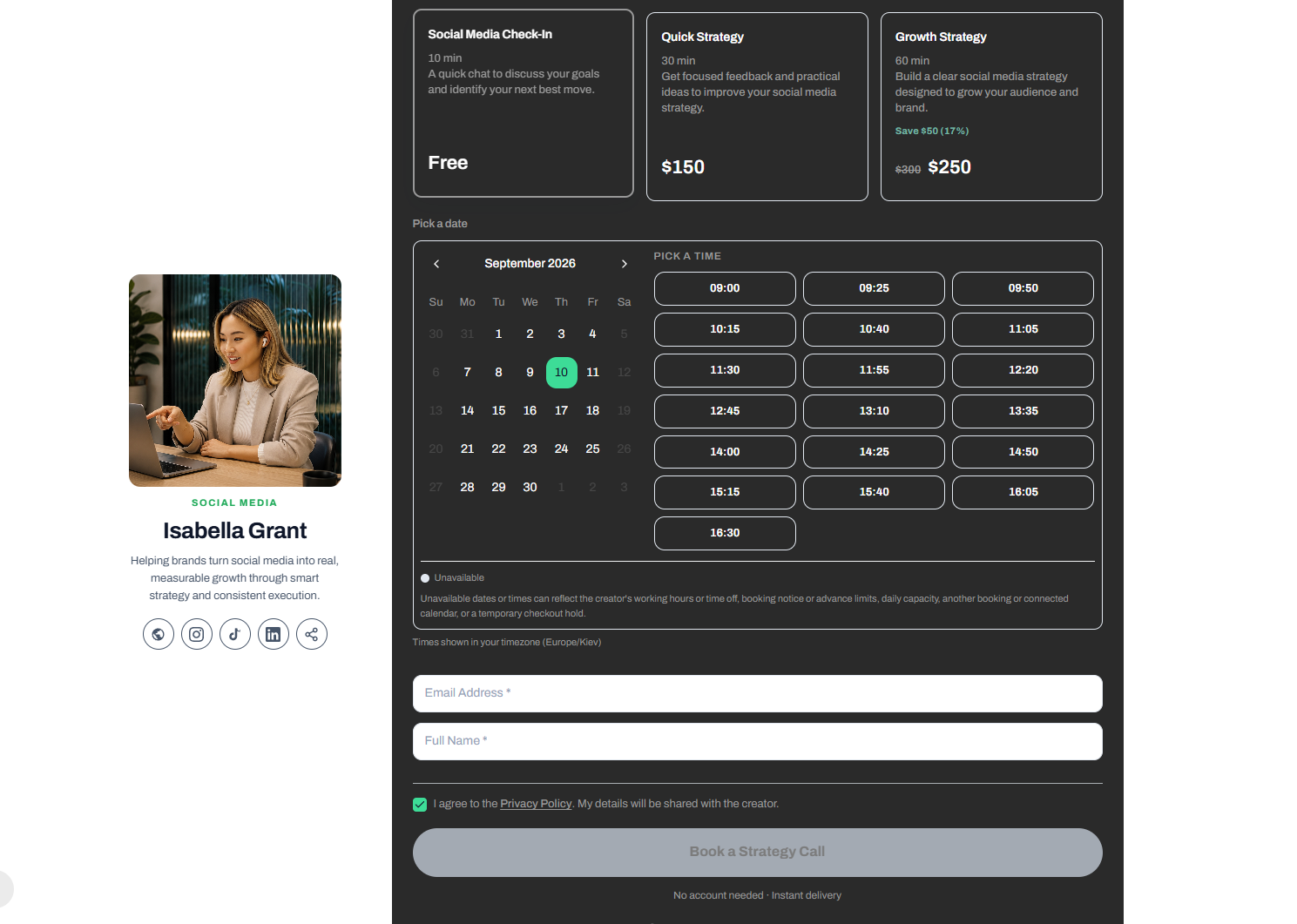
If you sell calls, consulting, or coaching, send subscribers to a booking page. In your emails, answer common questions, explain the result, and show what happens on the call.
Webinar flow
For live or evergreen webinars, use email to get people to sign up, remind them to join, follow up after the event, and share the next step.
Launch flow
For a bigger course or group program launch, send a focused promo sequence to the most interested segment instead of sending it to the full list.
HubSpot reports 4.6 billion email users in 2025 and 75% of marketers plan to maintain or increase email investment in 2026 . Email is still growing as a channel for conversions. For creators, the takeaway is simple: the list should do more than announce content. It should help guide people toward buying.
When the business runs through a storefront and booking system, keep the email calls to action direct and clear. Send readers to one offer page. Cut extra clicks. Make the next step obvious, especially when attention is limited and too many choices can slow people down before checkout. A storefront builder and booking platform such as creatorstore.co features can support that setup, especially for creators selling different types of offers from one central hub.
Track the metrics that actually matter in email marketing automation for creators
It’s easy to fixate on open rates because they’re visible, which can make them seem more important than they are. But that’s not the full story. Privacy changes made opens less reliable. And a high open rate means very little if nobody clicks or buys.
Focus on action-based metrics instead.
Core metrics to watch
Lead magnet conversion rate
Welcome sequence click rate
Subscriber-to-product-page rate
Subscriber-to-booking rate
Subscriber-to-purchase rate
Revenue per subscriber
Unsubscribe rate
Mailchimp reports an average unsubscribe rate of 0.22%, which is a helpful benchmark. Some unsubscribes are normal. They happen.
A smaller list of truly interested people is better than a big list filled with passive names. It’s that simple.
A simple scorecard
For every 100 people who visit your opt-in page, how many sign up?
Then, for every 100 new subscribers who enter your sequence, how many click? For every 100 clickers who reach your sales page, how many buy or book?
A simple creator email funnel scorecard
| Stage | Healthy question to ask | Why it matters |
|---|---|---|
| Opt-in | Are enough visitors joining the list? | Shows if your lead magnet and page are working |
| Welcome flow | Are subscribers clicking the emails? | Shows if your message matches their intent |
| Offer page | Are clicks turning into bookings or sales? | Shows if the product and page convert |
| Long-term list health | Do engaged subscribers stay active over time? | Shows if your content keeps trust strong |
That helps you stop chasing vanity metrics and fix the weak spot in the system.
Keep the system lean with current best practices
The best automation setup in 2026 isn’t the most complex one. Simpler usually works better. Research from Litmus, Mailjet, CleverReach, and others keeps pointing to the same small set of ideas: lifecycle automation, AI-assisted workflows, privacy-aware tracking, and mobile-first design.
For creators, that means a few practical guidelines.
Write for mobile first
Most of your audience is on a phone. Keep paragraphs short. Use one clear call to action. Put the link where people will actually see it.
Let AI help, but don’t hand over your voice
AI can help draft subject lines, plan sequences, and make testing faster. But your audience signed up for your point of view. Use AI as a tool, not as your voice.
Build around lifecycle moments
Your strongest flows often show up around clear moments: new subscriber, clicked interest, abandoned checkout, webinar signup, booked call, customer follow-up, and inactive subscriber.
Do not overdesign
Simple emails can win because they feel personal and are easy to read. Fancy layouts can pull attention away from the main action.
Advanced does not have to feel hard. More than that, it can mean cleaner logic, better timing, and messaging that feels more relevant.
Picking tools and setting up your stack for email marketing automation for creators
When creators compare tools, they sometimes focus only on email features. That matters, but it’s not enough, because automation works better when pages, products, bookings, and lead capture are all connected.
A good creator stack should help with these jobs:
Build landing pages fast
Add opt-in forms easily
Deliver free resources automatically
Sell digital products or services
Handle bookings if needed
Track clicks, sales, and signups
Stay simple enough to manage alone
Some creators use separate tools for every step. That can work, but it also adds friction. Pages break, tags don’t pass correctly, and follow-up gets messy. For solopreneurs, fewer moving parts make life easier.
All-in-one creator systems are starting to look more appealing for that reason. Using one tool for a link in bio, another for products, another for landing pages, and another for booking can make the whole setup harder to run. A connected stack makes email automation more reliable and easier to manage.
The best tool isn’t the one with the longest feature list. It’s the one that stays maintained and works well in daily use. Creators comparing options can also review creator platform solutions to see how connected storefronts and email workflows fit together.
Frequently Asked Questions
What is the easiest email marketing automation for creators to start with?
Start with one lead magnet, one opt-in page, and a 4 to 5 email welcome sequence. That is enough to build a basic creator email funnel without getting overwhelmed. You can add segmentation and sales branches later.
How many emails should be in a creator welcome sequence?
Most creators do well with 4 to 6 emails. That gives you enough room to deliver the freebie, share your story, teach something useful, and present an offer. If the sequence is helpful and focused, short usually works better than long.
What are the best lead magnets for creators selling digital products or coaching?
The best email capture and lead magnets solve a small problem that leads naturally to your paid offer. Templates, checklists, mini guides, short trainings, worksheets, and sample packs all work well. Pick something your ideal buyer wants now, not just something easy for you to make.
Do I need segmentation if my list is still small?
Yes, but keep it simple. Even a small list benefits from basic tags like source, interest, and buyer status. This helps you send more relevant emails without building a complex system.
Can I build an email funnel with a storefront and booking platform?
Yes. In fact, that is often easier because your traffic, offers, and signups live in one place. A platform like creatorstore.co can support this by combining storefront pages, bookings, landing pages, and email capture so your funnel is easier to manage.
What should creators track besides open rate?
Focus on clicks, bookings, purchases, opt-in conversion, and revenue per subscriber. Those numbers tell you whether your email marketing automation for creators is actually driving business results. If you use a connected system such as a creator storefront and booking platform , it can also be easier to see how email actions connect to product sales or service bookings.
Common mistakes to avoid as you grow
A few mistakes come up again and again in creator email systems. The good news is that every one of them is fixable.
First, don’t create a lead magnet that brings in the wrong audience. Freebies should attract future buyers, not a pile of random subscribers. And don’t wait too long to make an offer. Nurture emails should build trust, but they also need a clear goal.
Another common mistake is sending the same message to everyone all the time. That gets old fast. Even basic segmentation can make emails feel much more relevant.
Then there’s adding too many tools too early, when a simple system is easier to manage and a lot less messy. Keep it simple. Also, don’t judge success by opens alone. Clicks, bookings, purchases, and list quality tell a much clearer story.
If there’s one thing to remember, it’s this: email should support the business model. It’s more than content. It’s the relationship channel, and it should also help turn interest into sales.
Now build the version you can actually maintain
You don’t need a huge marketing machine to make email work. You need a practical system that fits your creator business right now, not an overbuilt setup that’s hard to run or tough to maintain. Start small. Pick one strong lead magnet. Add a single opt-in page. Then write a short welcome sequence with 4 to 6 emails, connect it to a paid offer or booking page, and improve it step by step.
Here’s the simple plan:
Build email capture and lead magnets tied to a real offer
Create a 4 to 6 email welcome sequence
Segment by source, interest, and buyer status
Send subscribers to one clear product or booking page
Track clicks, purchases, and bookings instead of focusing only on opens
Keep the design simple and mobile-friendly
Add more flows after the first one is working
For creators, email marketing automation starts there. It’s simple and useful. It gives creators a system they can actually control, helps turn followers into subscribers and subscribers into customers, and can even turn one-time buyers into long-term fans. Social media can still bring attention. A creator email funnel helps turn that attention into more steady revenue.
The best time to build the funnel was when the creator first started posting. The second-best time is now.