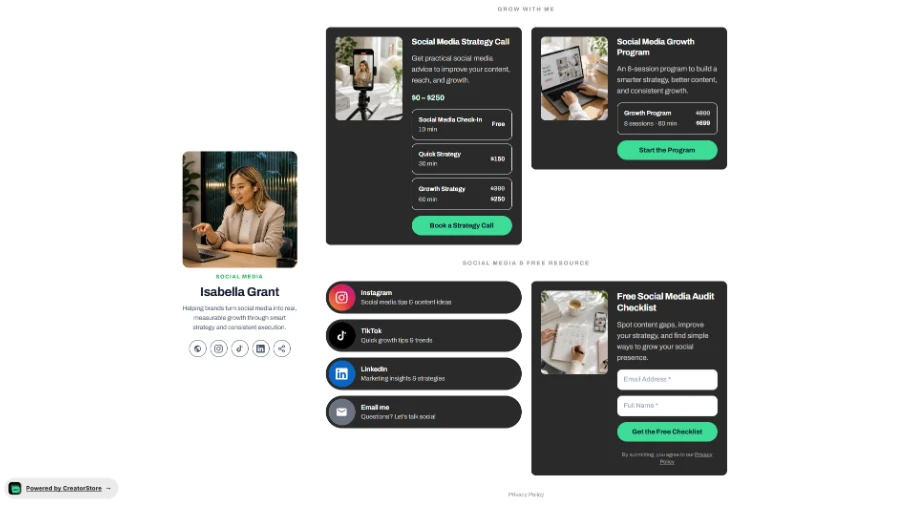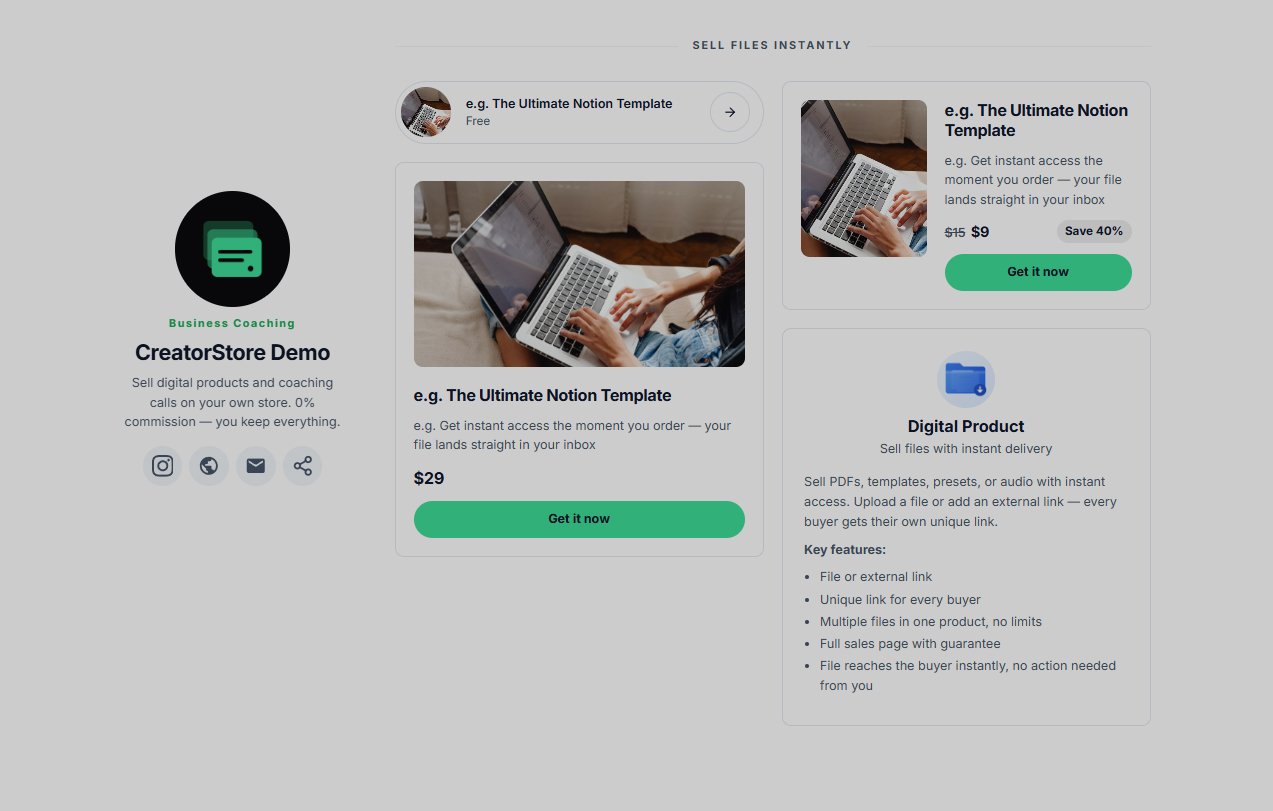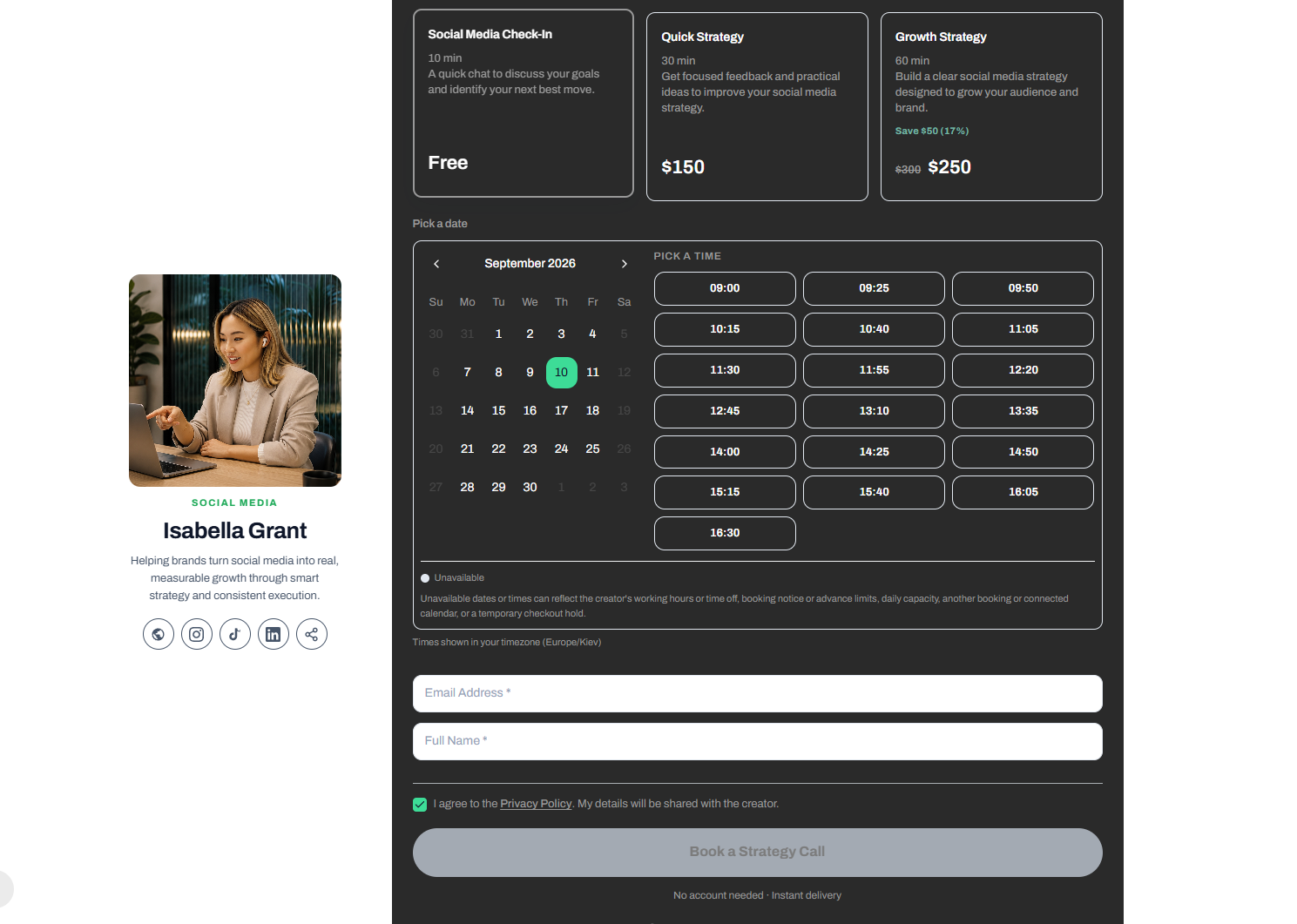
Once a client decides to book a 1:1 coaching call, everything has to just work: they pick a time, pay, and get a confirmation with the meeting link — without you touching a thing. That's what a proper booking setup does.
In this guide, you'll set up paid 1:1 coaching calls in Creator Store step by step: create the product, configure the checkout, define session types and prices, and automate confirmation emails. By the end, your booking page will be live and taking payments.
1. Define What Your Coaching Call Actually Helps With
"Book a call with me" doesn't tell anyone what they're buying. It puts the burden on the buyer to guess whether you can help with their specific situation — and most people won't take that risk on an unclear offer.
A stronger starting point names the outcome directly: a portfolio review, a channel audit, a strategy session for a specific business stage, a career transition consultation, or a content review.
These are examples of the shape a clear offer takes, not a list to pick from. The actual offer should come from what you specifically know how to help with.
The test is simple:
Can you finish the sentence "This call helps you [specific outcome]" without it being vague enough to apply to almost anyone?
2. Decide Exactly Who the Call Is For
Once you know what the call helps with, the next question is who it's for.
Not "anyone who needs advice" — a specific type of person in a specific situation.
A useful way to check this is to complete the sentence:
I help [type of person] with [specific problem or outcome].
If the "type of person" part is broad enough to describe most of the population, it needs to be narrower.
If it's specific enough that a stranger reading it would either think "that's me" or "that's clearly not me," you're in a good place.
Avoid promising specific results as part of this positioning. You can be clear about what the session covers and who it's for without guaranteeing an outcome you can't actually control.
3. Choose the Format and Scope of the Session
A few practical decisions shape what you're actually selling.
Session Length
There's no universally correct length. A focused review might need 30 minutes, while a strategic session might need 60 minutes or more.
The right length depends on what has to happen during the call, not on a general rule.
One-Off Call vs. Ongoing Support
Decide whether you're selling a single session or something recurring.
Both are legitimate models, but they set different expectations.
A one-off call should feel complete on its own, while ongoing support implies an ongoing relationship.
What Happens Before the Call
Will the client:
Fill out an intake form?
Send materials in advance?
Share specific questions?
Or simply show up for the session?
Deciding this early avoids spending the first five minutes of every call figuring out the context.
What Happens During the Call
Is the session:
Advice?
A working session?
Feedback on something specific?
A strategic discussion?
Or a combination of these?
Being clear with yourself about this makes it much easier to explain to the buyer.
What the Client Receives Afterwards
Decide in advance whether the client receives:
Notes.
A recording.
A written summary.
An action plan.
Additional resources.
Don't wait until after your first sale to decide what happens next.
Boundaries Around Follow-Up
Are follow-up questions included, or is additional support a separate offer?
Unclear boundaries can easily lead to scope creep and frustration on both sides.
4. Price the Coaching Call
There's no universal correct price for a coaching call.
What affects a reasonable price for your specific offer includes:
Scope — how much ground the call covers.
Your expertise — genuinely relevant to the problem, not just general experience.
Preparation required — reviewing materials before the call takes time.
Session length.
Follow-up work included — such as a summary or action plan.
Complexity of the problem — a narrow question is different from an open-ended strategic conversation.
Additional deliverables — for example, a written report alongside the call.
If it helps to think through pricing, start with the total amount of time the session requires.
For example:
If a session takes 90 minutes including preparation and follow-up, decide what that 90 minutes needs to be worth for your business.
This isn't a market rate to copy. It's simply a way to calculate whether the price makes sense for the amount of work involved.
Expect to revisit your pricing as you learn how much preparation, delivery, and follow-up the offer actually requires.
5. Create a Page That Makes the Offer Clear
Wherever someone lands before booking, the page should answer the important questions quickly.
Include:
Who the call is for — specific enough that the right person recognizes themselves.
The problem or outcome — what the session helps with.
What happens during the session — so there's no ambiguity about the format.
What's included — length, materials, and follow-up.
Session duration.
Price.
What happens after payment — how they book a time and receive confirmation.
Cancellation or rescheduling policy.
A short FAQ — answering the most likely questions before booking.
The goal isn't polished marketing copy.
The goal is to remove the questions a hesitant buyer might have before they're willing to pay.
6. Set Up Scheduling and Payment
Regardless of the tools you use, the buyer journey follows the same basic shape:
Offer page → Choose a time → Pay → Receive confirmation → Join the call
The fewer manual steps in that chain, the fewer people are likely to drop off.
A buyer who has to:
Email you to check availability.
Wait for your reply.
Choose a time.
Arrange payment separately.
Has more opportunities to lose momentum than someone who can book and pay in one flow.
This doesn't require anything complicated. The goal is simply to remove unnecessary steps where the process depends on you personally replying before the buyer can move forward.
7. Prepare Before the Call
A few things can make a session noticeably more useful for the client.
Use Intake Questions
Ask what they want to get out of the call so you're not spending the first few minutes figuring that out live.
Review Relevant Materials
If they've sent something in advance, review it before the call rather than spending the session reading it.
Clarify Their Main Goal
Sometimes what someone books for isn't quite what they actually need.
A quick check at the beginning of the call — or in the intake form — can surface this early.
Prepare Notes
Even a short outline of what you want to cover can help keep the session focused.
Make Sure the Meeting Details Are Clear
Confirm:
The correct meeting link.
The date and time.
The time zone.
Any preparation required before the session.
8. Deliver a Useful, Structured Session
A simple structure can keep most calls productive, regardless of the topic.
1. Confirm the Goal
Briefly restate what the client wants to get out of the session.
2. Understand the Context
Get enough background information to give a relevant answer without letting the entire session turn into background explanation.
3. Identify the Highest-Priority Issue
Often, one issue matters more than everything else.
Try to identify it early.
4. Work Through Recommendations or Options
This is the core of the session.
Depending on your offer, this might involve feedback, advice, strategy, problem-solving, or working together on something specific.
5. Finish With Clear Next Actions
The client should leave knowing what to do next.
That might be:
A specific task.
A decision.
A list of priorities.
A plan for the next few days or weeks.
Important: If your offer touches on medical, mental health, legal, financial, or another regulated area, general coaching or consulting isn't automatically the same as being qualified to provide that regulated service. Requirements depend on your qualifications, jurisdiction, and the nature of what you're advising on.
9. Follow Up After the Call
What happens after the session can matter almost as much as the session itself.
Consider including:
A Summary or Next Steps
Where it fits the offer, even a short follow-up note can reinforce what was covered and what the client should do next.
Any Promised Resources or Deliverables
Send them promptly rather than leaving the client waiting.
Clear Boundaries Around Further Questions
If follow-up isn't included in the price, it's better to make that clear than leave it ambiguous.
Feedback
Where genuinely appropriate, ask for feedback after the client has had time to use what you discussed.
A simple, low-pressure question is usually enough.
10. Improve the Offer as You Sell More Calls
Once you've delivered a handful of sessions, patterns usually start to appear.
For example:
If multiple people ask the same question before booking, add the answer to your page or FAQ.
If clients regularly arrive without the context you need, improve your intake form.
If the same goals keep coming up, make your positioning more specific.
If certain parts of the session consistently create the most value, make them a clearer part of the offer.
You don't need to guess what to improve.
The questions, hesitations, and confusion points your actual clients raise are some of the most useful signals you'll get.
Selling Coaching Calls with CreatorStore
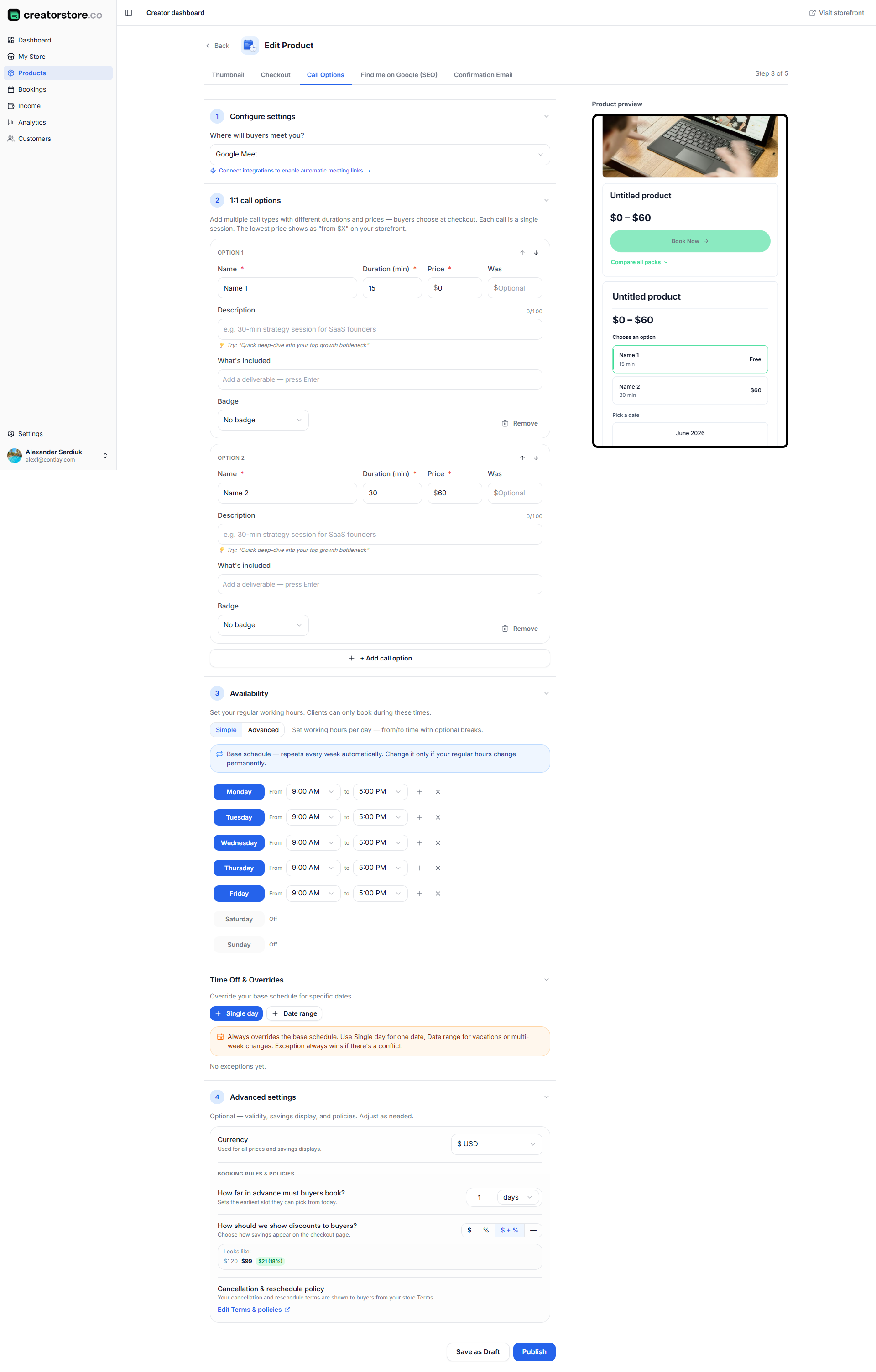
CreatorStore lets you sell 1:1 coaching calls with scheduling and payment handled in one flow.
You can create a dedicated page for your session, let clients choose an available time, collect payment, and manage the booking process without sending people through multiple separate steps.
CreatorStore charges 0% platform commission on sales.
FAQ
Do I Need a Coaching Certification to Sell Coaching Calls?
Not for general coaching or consulting in many cases, but this depends heavily on what you're actually offering, your jurisdiction, and whether the topic touches on a regulated profession.
General business, career, or creative coaching may be treated differently from medical, mental health, legal, or financial advice, where specific qualifications or licensing requirements can apply.
It's worth checking your specific situation rather than assuming either way.
How Long Should a Coaching Call Be?
There's no single correct length.
It depends on what needs to happen during the session.
A focused review might require less time than an open-ended strategic conversation.
Choose a session length based on the scope of what you're actually delivering.
How Should I Price a 1:1 Coaching Call?
Consider:
The scope of the session.
Your relevant expertise.
Preparation time.
Follow-up work.
Session length.
The complexity of the problem.
Any additional deliverables.
There isn't one market-average number that applies to every type of coaching call.
It's normal to revisit your pricing once you've delivered real sessions and understand how much time the offer actually requires.
Should Clients Pay Before Booking?
Collecting payment as part of the booking flow can simplify the process by avoiding a separate invoice or payment step.
Whether payment is required before confirming a session depends on how you structure your offer.
Can I Sell One-Off Calls and Coaching Packages?
Yes.
You can offer:
A single session for someone who wants focused help with one issue.
A package of multiple sessions for someone who wants ongoing support.
These are different offers and can have different pricing structures.
What Should I Include on a Coaching Booking Page?
At minimum, include:
Who the call is for.
What problem or outcome it addresses.
What happens during the session.
What's included.
Session duration.
Price.
What happens after payment.
Cancellation or rescheduling information.
A short FAQ answering the most common questions can also help remove hesitation before booking.