There's no single "best" digital product — only the one that fits what you already know, who you already reach, and how much ongoing work you're willing to put into it.
"Best," in this article, means worth considering based on your own skills, audience, and existing assets — not a ranking of what sells most or earns the most.
The right format depends on a few things: what you know well enough to package into something useful, what your audience actually needs help with, how much delivery or support the product will require after someone buys it, and whether it solves a problem clearly enough that the outcome is obvious before someone pays.
This isn't a ranked list. It's a set of realistic formats worth considering, organized so you can find the ones that actually fit your situation.
What Makes a Digital Product Worth Selling?
Before looking at formats, it helps to know what separates a product people buy from one that just sits unsold.
It solves a clear problem. Not a vague benefit like "get organized" — a specific frustration someone is actively dealing with.
It's built for a specific audience. The more precisely you can describe who it's for, the easier it is for the right person to recognize it as made for them.
You already have the knowledge, workflow, or assets behind it. A practical starting point is something you already built for yourself or a workflow you already understand.
The outcome is easy to understand. Someone should be able to tell what they're getting and why it helps within a few seconds of looking at it.
It's realistic for you to create and maintain. Some formats need almost no ongoing involvement after launch; others need updates, support, or your continued presence. Both are valid — but worth knowing which one you're signing up for.
Digital Product Ideas to Consider
These are grouped by category to help you scan for what fits — not ranked by how well any of them sell.
Templates & Productivity Tools
Templates work well when someone has a recurring task they'd rather not rebuild from scratch every time.
Notion Templates
Pre-built systems for planning, tracking, or managing something in Notion. Useful for anyone with a repeatable workflow in an area they understand, from personal productivity to business operations.
If a Notion template is the direction you're leaning toward, Notion Template Ideas to Sell covers this category in more depth.
Spreadsheet Templates
For people who need calculations or tracking but don't want to build a spreadsheet from a blank sheet.
Works well for budgets, project timelines, or any recurring calculation-heavy task. Gets stronger when built around a specific use case, like a freelancer's quarterly tax estimate spreadsheet rather than a generic budget sheet.
Budgeting Templates
For people trying to get a handle on personal or business finances without full accounting software.
More useful when tailored to a specific financial situation — a template for irregular freelance income looks different from one for a fixed salary.
Project Management Templates
For teams or individuals coordinating multiple moving pieces.
Works best when scoped to a specific kind of project rather than a generic all-purpose tracker.
Content Calendars
For anyone planning content across one or more platforms ahead of time instead of posting reactively.
Business Templates
Examples include proposals, contracts, and SOPs.
Useful for small business owners or freelancers who repeat the same document types with each client. They become stronger when built around a specific service or industry.
Client Onboarding Templates
For service providers who want a consistent first-client experience instead of reinventing onboarding steps each time.
Resume and CV Templates
For job seekers who want a polished, structured document without starting from a blank page.
Works better when adapted to a specific field or career stage, since what stands out on a resume differs by industry.
Presentation Templates
For anyone who regularly builds slide decks and wants a professional starting point instead of default software templates.
Design Templates
Social media graphics, print materials, and other reusable visual assets.
Useful for people who need to produce visual content regularly but don't have the time to start from scratch each time.
Guides, Ebooks & Educational Downloads
These formats differ mainly in depth and structure — picking the right one depends on how much you're teaching and how someone will use it.
Ebooks
Best for a topic that benefits from a full narrative or structured explanation, read from start to finish rather than referenced repeatedly.
Practical Guides
Shorter and more action-oriented than an ebook, usually built around walking someone through a specific process.
Checklists
Best when the value is in not missing a step, rather than explaining why each step matters.
They can also work well as a companion to a deeper product.
Cheat Sheets
A fast-reference format for something someone needs to look up repeatedly rather than read once.
Workbooks
Useful for topics that benefit from the reader doing exercises or filling in their own information, not just reading passively.
Playbooks
Best for a repeatable process with specific steps and decision points, often used in business or marketing contexts.
Swipe Files
Collections of examples — such as headlines, email templates, or page layouts — that someone can adapt rather than create from scratch.
Resource Libraries
A curated collection of tools, links, or references organized around a specific need.
The value comes from the curation itself: knowing what's actually worth using.
Creative Assets
These formats work well for creators with visual, audio, or design skills.
Lightroom and Photo Presets
Pre-built editing settings for photographers or content creators who want a consistent look without manually adjusting each photo.
LUTs
Video color grading presets for creators who want a consistent visual style across footage.
Fonts
For designers or creators who have built a genuinely original typeface.
Icon Packs
For designers or content creators who need a consistent visual style across a project.
Illustration Packs
Pre-made illustrations for people who need visual assets but don't want to commission custom art for every project.
Stock Photos
Original photography licensed for others to use in their own projects.
Video Assets
Overlays, transitions, templates, and other assets for video editors who want to speed up repetitive parts of their editing process.
Music and Sample Packs
Original audio for producers or content creators to use in their own work.
Sound Effects
Short audio assets used in video or audio production.
Digital Art
Original artwork sold as downloadable files, prints, or licensed assets.
Printable Assets
Planners, wall art, invitations, and other products designed to be printed by the buyer.
Note: Only sell creative assets you actually created or have clear rights to redistribute. Purchasing access to a font, sample pack, or stock image for your own use doesn't automatically give you the right to resell it as part of another product.
Courses & Learning Products
These formats differ mainly in how much structure and live support is involved.
Self-Paced Courses
Pre-recorded material a buyer works through on their own schedule, with no live component required after launch.
Mini-Courses
A smaller, narrower version of a full course, useful when the topic doesn't need a multi-week structure.
Workshops
Typically a single live or recorded session focused on one specific skill or outcome.
Recorded Masterclasses
A one-time deep dive on a topic, positioned as expert-level content rather than a beginner curriculum.
Cohort-Based Programs
A group of students moving through material together on a schedule, usually with live sessions and more direct interaction.
This format requires more ongoing time because it's live and scheduled rather than fully automated.
Creator-Specific Products
These products are built around problems that come up specifically in content creation.
YouTube Creator Resources
Thumbnail templates, script frameworks, and channel-audit checklists for creators who want to simplify parts of video production.
Social Media Content Systems
Templates or frameworks for planning and producing consistent content across platforms.
Newsletter Resources
Templates and subject-line swipe files for writers running a regular newsletter.
Podcast Resources
Interview question banks and production checklists for podcasters managing the parts of production beyond recording.
Sponsorship and Brand Deal Resources
Rate card templates and pitch templates for creators navigating brand partnerships.
Creator Media Kit Templates
A presentable summary of a creator's audience and past work, used when pitching to brands or partners.
Content Repurposing Systems
Frameworks for turning one piece of content into multiple formats without starting from scratch each time.
Professional & Niche Products
Specificity is what makes these genuinely useful — a resource built for one profession's actual workflow, not a generic version with the job title swapped in.
Freelancer Resources
Contract templates and scope-of-work documents for freelancers who need professional documents for client work.
Coaching Resources
Session frameworks and client intake forms for coaches who want structured tools for their practice.
Consultant Frameworks
Assessment templates and engagement structures for consultants who want to standardize how they scope and run client work.
Photographer Resources
Contracts, shot lists, and client questionnaires for photographers managing the business side of shoots.
Designer Resources
Project templates and client feedback forms for designers managing revisions and communication.
Teacher Resources
Lesson plans and classroom management tools for educators who want ready-made structure for recurring teaching tasks.
Fitness Professional Resources
Program templates and client check-in forms for trainers or coaches managing multiple clients.
Real Estate Resources
Listing templates and client communication scripts for agents managing repetitive parts of client transactions.
Small Business Systems
Inventory templates and basic operations trackers for small business owners who need more structure than a spreadsheet but don't need full business software.
None of these formats are included because they perform better than the others. They're here because a clear problem and a specific audience can make any of these directions more useful.
How to Choose the Right Digital Product for You
With so many options, narrowing down comes back to a few questions:
- What do people already ask me for help with?
Recurring questions can point to a recurring problem worth solving once as a product.
- What workflow or asset have I already created for myself?
Something you built out of necessity may already be further along than you think.
- Can I name one specific buyer?
Not a broad category — an actual type of person you can picture using it.
- What outcome does the product provide?
If you can't explain it in one sentence, the idea may need to be narrower.
- How much ongoing support will this require?
A cohort-based program and a downloadable template require very different levels of involvement.
Start Small Instead of Building Everything at Once
It's tempting to plan a huge course, a massive bundle, or a dozen products before launching anything.
Starting with one clear, well-defined offer is usually more manageable — and it gives you real feedback before you invest time building more.
Pay attention to:
Questions people ask.
Where people get confused.
What they request.
What additional problems they need help solving.
You can always expand into a bundle, a second format, or a bigger offer once you know the first one works for the people buying it.
Selling Digital Products with CreatorStore
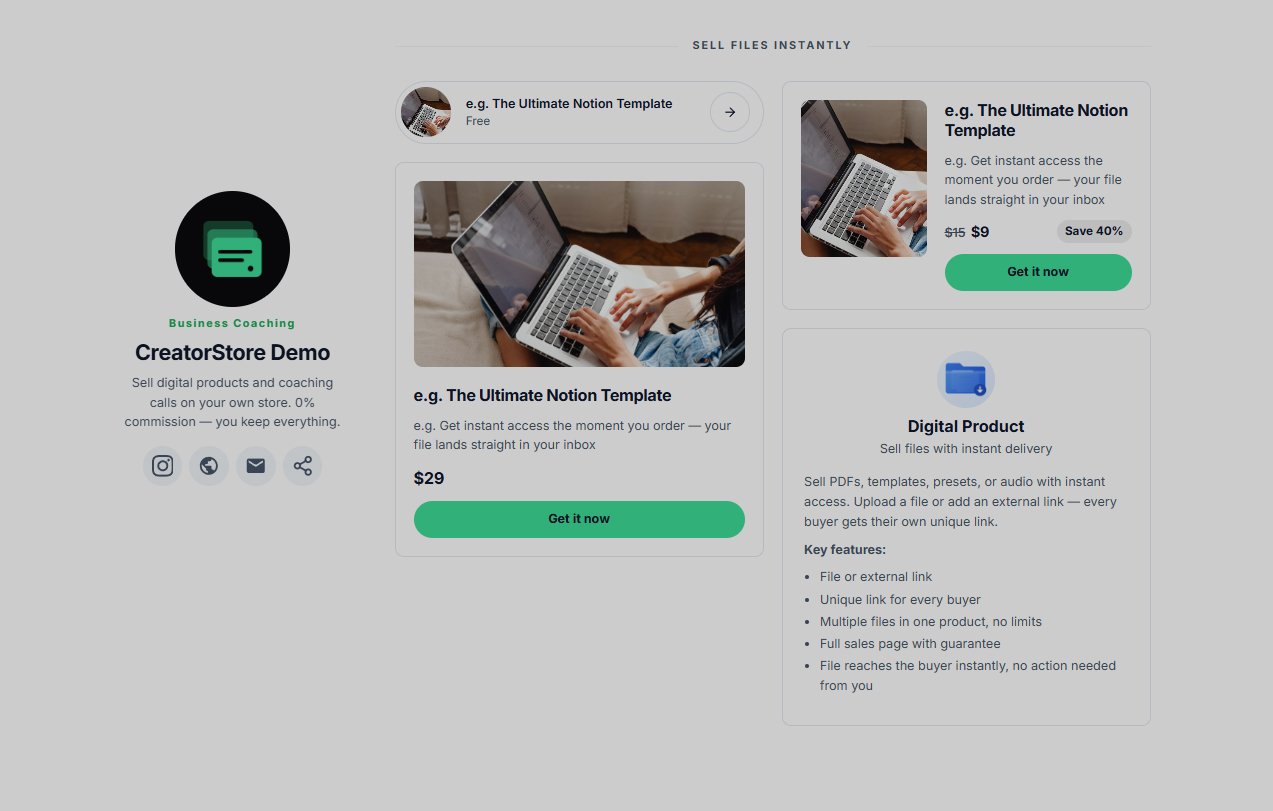
Once you've settled on a format, CreatorStore gives you a storefront to sell it directly — with instant delivery after payment, 0% platform commission, and a dedicated sales page for each product.
You keep the full list of everyone who buys from you, can connect a custom domain, and can bundle multiple products together as your catalog grows.
If a Notion template is the direction you're leaning toward, How to Sell Notion Templates in 2026 covers the process once you've picked an idea.
FAQ
What is a digital product?
A digital product is something you create once and sell repeatedly without producing a new physical copy each time.
Examples include files, templates, courses, presets, guides, and other downloadable or online products. The value is in the content or system itself, not in a physical object being shipped.
What digital products can beginners sell?
Formats that don't require specialized production tools are often the most approachable starting point.
This can include:
Templates
Checklists
Guides
Workbooks
Simple digital resources
That doesn't mean other formats are off-limits — these simply require less setup before your first launch.
Do I need an audience before selling a digital product?
No, but it changes how you get your first sales.
Without an existing audience, you'll rely more on discovery through marketplaces, search, communities, partnerships, or direct outreach.
With an audience, you can sell directly to people who already know and trust your work.
Can I sell more than one type of digital product?
Yes.
You can start with one format and add others later. You can also combine complementary products into bundles as your catalog grows.
Where can I sell digital products?
You can sell digital products through:
Platforms built for specific product types.
General-purpose marketplaces.
Your own storefront.
Each option comes with a different trade-off between built-in discovery and how much control you have over the sale and customer relationship.
A direct storefront lets you build your own product catalog and sell directly to your audience.